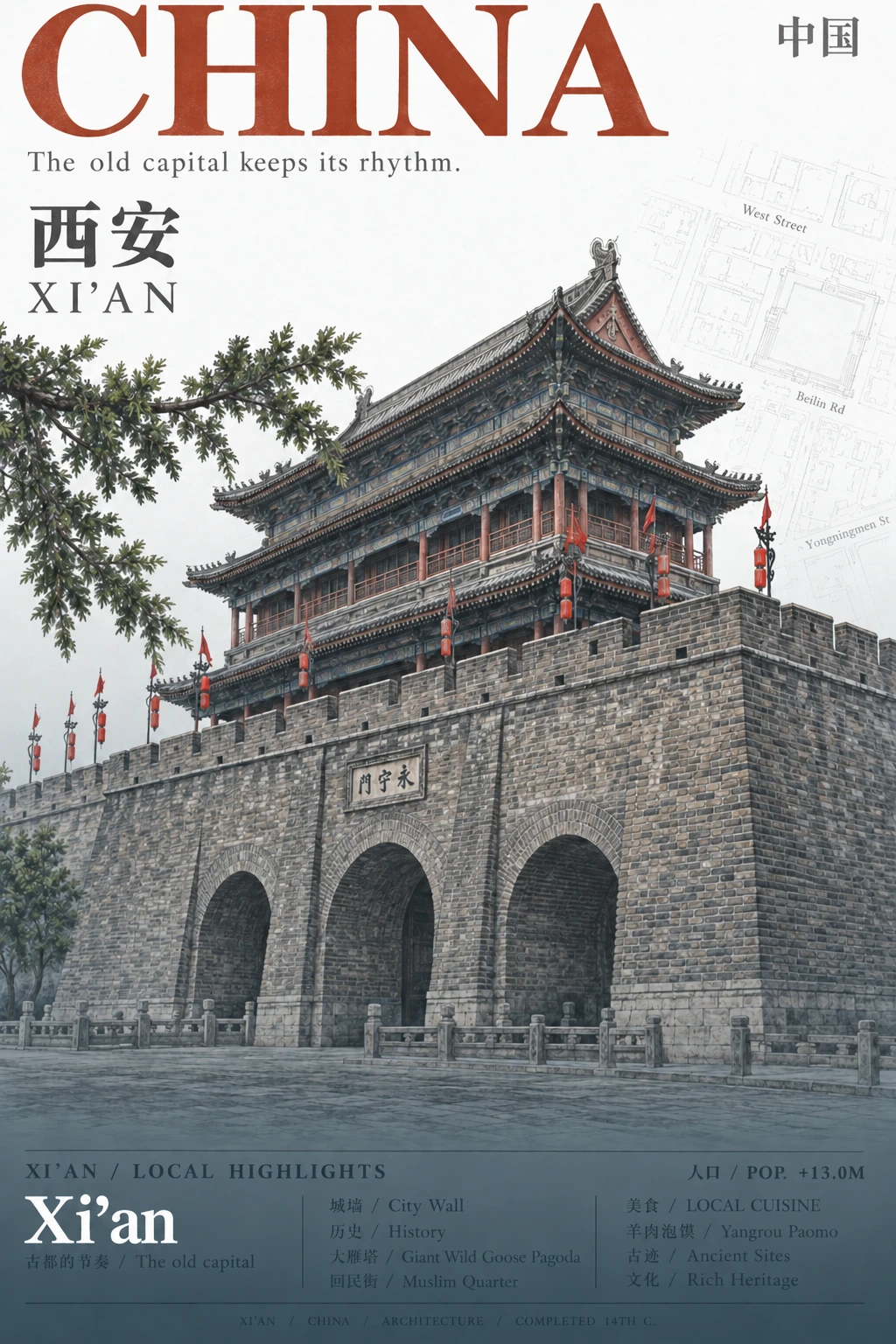
An old capital, still inhabited
Xi’an
Xi’an is an ancient capital with a living appetite: city walls, Muslim Quarter smoke, Buddhist history and the broad confidence of northwest China.
City overview
City walls, museums and Silk Road history
01 / Context
A city built in layers
Xi’an’s depth is not confined to archaeology. As the starting point of the Silk Roads and capital of several dynasties, it still carries an unusual sense of orientation: walls define the old city; gate towers frame the distance; neighbourhoods keep everyday life within the historical boundary.
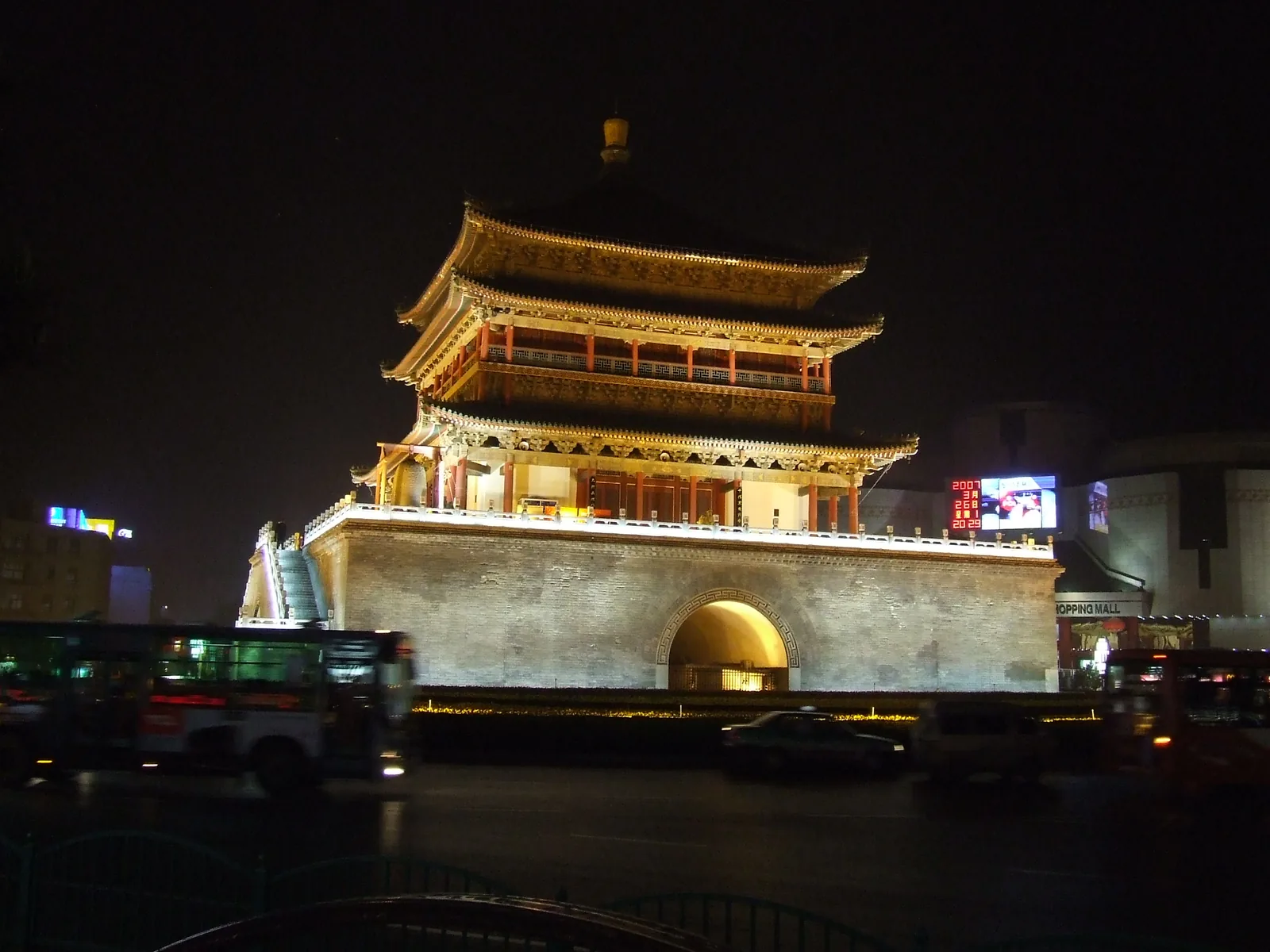
The Bell Tower is less important as a photo stop than as a reminder of how the city is organised. From here, walk outward to let the scale give way to street life.

02 / Culture
Faith, trade and the table
The Muslim Quarter is often introduced through snacks, but its significance is deeper: it shows how trade, migration and religious life became part of Xi’an’s urban identity. The Great Mosque and surrounding lanes offer a richer view than a rushed food crawl.
In the old city, the best moments arrive through contrast — quiet courtyards after crowded lanes, a formal gate after a bowl of hand-pulled noodles.
03 / Place
The wall as a public horizon
Xi’an’s city wall turns defensive history into contemporary public space. Walk or cycle it slowly in the late afternoon; it gives the old city a readable outline and offers a rare, continuous view across roofs, towers and new development.
Good to know
Begin with context
For three full days, consider an old-city and wall day, a Terracotta Warriors outing and a separate museum day. Fix museum reservations before choosing the order.
Make room for food
Leave time for a meal around the Muslim Quarter rather than only a quick snack stop. Ask about ingredients and respect access rules at places of worship.
Keep the pace slow
Check the Terracotta Warriors museum’s official ticket instructions before travelling. For Shaanxi History Museum, confirm the branch, reservation and booked identity document; the main museum and Qinhan gallery are separate venues.
A closer reading
Five lenses on Xi’an.
History
The long view
Culture
Everyday culture
Landscape
Ground and horizon
Food
At the table
Now
A city in motion
Watch
See Xi’an in motion.
A visual companion to the guide, selected for places, pace and everyday detail.
Plan with ChinaVela
Travel deeper, with the right local context.
Talk to a travel specialistPlan your visit
Journeys that include this destination: Xi’an, a journey through dynasties · Xi’an, Yellow River & canyon country.
Other city guides: Chengdu city guide · Chongqing city guide.
All China city guides · Explore China journeys · Before you go to China